

Quick answer
Teotihuacan hot air balloon safety depends on three pillars: operator certification by DGAC (Dirección General de Aeronáutica Civil), adherence to weather launch windows that prohibit flights when ground winds exceed 10 knots or visibility drops below 5 kilometers, and basket capacity limits of 12-16 passengers with mandatory weight distribution. Licensed pilots complete annual flight hour requirements and medical examinations, while balloons undergo monthly envelope and burner inspections documented in maintenance logs available for passenger review upon request.
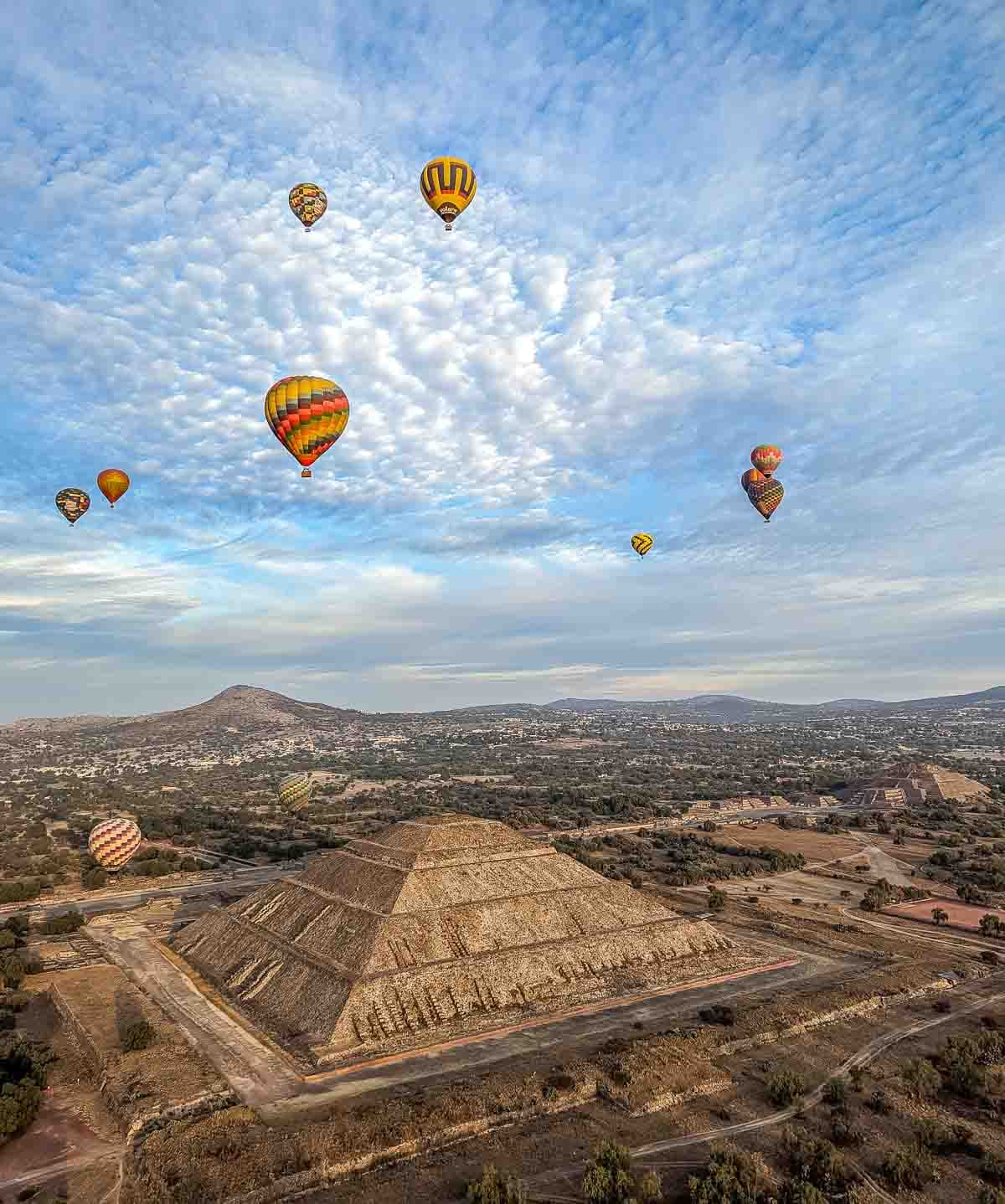
Every commercial balloon lifting off near the Pyramid of the Sun carries a wicker basket rated for impact loads three times its maximum passenger weight. That engineering margin exists because balloon landings, even textbook ones, involve controlled descent onto uneven terrain where the basket may tip or drag before the envelope deflates. Passengers stand throughout the flight, knees slightly bent, holding padded grip rails welded to the basket frame. Mexico's civil aviation authority mandates that balloon operators serving the Teotihuacan corridor hold Air Operator Certificates renewed every two years. These certificates require proof of liability insurance, pilot logbooks showing at least 200 supervised flight hours, and maintenance contracts with certified repair stations. The envelope fabric—rip-stop nylon coated with polyurethane—degrades under UV exposure, so operators replace panels or retire envelopes after 400-500 flight hours. Passengers can verify an operator's certificate status by requesting the DGAC registration number and cross-checking it against the public aviation registry before booking. Weather determines whether balloons launch. Ground crews measure wind speed with handheld anemometers starting ninety minutes before sunrise, the only launch window that offers stable air. If winds exceed 10 knots at ground level or forecasts predict gusts above 15 knots aloft, flights cancel. The volcanic landscape surrounding Teotihuacan creates thermal currents as the sun heats exposed rock, making post-sunrise flights turbulent and unsafe. Operators who launch late or ignore wind limits violate teotihuacan hot air balloon safety protocols and risk license suspension. Pilots control altitude by heating the air inside the envelope with propane burners that produce flames reaching two meters. Passengers stand directly below this heat source, separated by a steel frame and flame-resistant fabric baffles.Burn duration rarely exceeds five seconds per blast—longer burns overheat the envelope crown and waste fuel. A standard flight consumes 30-40 kilograms of propane, enough for 60-75 minutes aloft. Reserve fuel and a secondary ignition system provide redundancy if the primary burner fails, allowing controlled descent to the nearest clear landing zone. Emergency procedures assume the basket will tip on landing. Pilots brief passengers to crouch, grip the rails, and keep knees bent to absorb impact. Chase crews in ground vehicles follow the balloon's drift path, communicating via radio to confirm the landing zone is clear of power lines, livestock, and irrigation ditches. Post-landing, passengers exit only after the pilot deflates the envelope and secures the basket—a process taking three to five minutes during which residual heat keeps the fabric taut.
“Operators who launch late or ignore wind limits violate safety protocols and risk license suspension.”
Essential Teotihuacan Hot Air Balloon Safety Protocols
Hot air balloon flights over Teotihuacan require strict adherence to weight restrictions, health declarations, and passenger conduct protocols to ensure safe operation at altitude above the archaeological zone.
Do
- Declare your accurate weight during booking for load calculations
- Wear closed-toe shoes and layers for early morning temperatures
- Follow pilot instructions immediately during launch and landing phases
- Inform operators of pregnancy, heart conditions, or recent surgeries
- Arrive sober and well-rested for the pre-flight safety briefing
- Hold basket handrails firmly during ascent and descent
Don't
- Don't exceed the 120 kg individual weight limit per passenger
- Don't bring loose items that could fall from the basket
- Don't lean over basket edges or shift weight suddenly during flight
- Don't fly if you've been scuba diving within 24 hours
- Don't consume alcohol before your scheduled flight time
- Don't ignore altitude discomfort or dizziness without alerting crew
Pre-Flight Checklist for Teotihuacan Hot Air Balloon Safety
Complete these steps before your flight to ensure a safe and smooth experience above the pyramids.
-
Confirm your booking 24–48 hours before departure — Operators may cancel or reschedule due to weather, and early confirmation avoids last-minute surprises.
-
Wear closed-toe shoes with ankle support — Balloon baskets require steady footing during takeoff and landing on uneven ground.
-
Dress in layers for temperature shifts — Pre-dawn temperatures can drop to 5°C, while post-flight sun exposure increases heat rapidly.
-
Check the cancellation policy for weather delays — High winds or poor visibility can ground flights with little notice, and policies vary by operator.
-
Bring a hat and sunscreen for ground time — You'll spend 30–60 minutes outdoors before and after the flight with limited shade.
-
Avoid heavy meals within two hours of departure — Early morning flights and altitude changes can trigger nausea in sensitive passengers.
-
Confirm pickup times if transport is included — Most operators offer hotel transfers departing between 04:30 and 05:30 to reach launch sites by dawn.
Optimal Timing for Teotihuacan Hot Air Balloon Safety
Hot air balloon flights operate exclusively during the early morning hours to prioritize safety by avoiding unstable thermal activity and high winds. This narrow window provides the calmest atmospheric conditions necessary for balloon navigation.
Spring (March–May)
ModerateMild temperatures 12°C to 24°C
Predictable wind patterns support consistent morning launches.
Summer (June–August)
HighWarm with frequent rain 14°C to 26°C
Early morning departures minimize disruption from afternoon storm development.
Autumn (September–November)
ModerateCooler air 10°C to 22°C
Clear skies offer stable flight conditions for balloon safety.
Winter (December–February)
LowCold mornings 4°C to 20°C
Crisp air provides excellent visibility and high atmospheric stability.
Verdict: The best time for hot air balloon flights is during the spring or autumn months on weekday mornings, when atmospheric stability is highest.
Teotihuacan Site Opening Hours and Flight Coordination
The Teotihuacan archaeological zone is open daily to the public. While hot air balloon flights typically launch before these hours, visitors may enter the site during the following times to explore the ruins after their flight.
| Monday | 08:00–17:00 | |
|---|---|---|
| Tuesday | 08:00–17:00 | |
| Wednesday | 08:00–17:00 | |
| Thursday | 08:00–17:00 | |
| Friday | 08:00–17:00 | |
| Saturday | 08:00–17:00 | |
| Sunday | 08:00–17:00 |
Check availability
Frequently Asked Questions About Teotihuacan Hot Air Balloon Safety
Everything you need to know about teotihuacan hot air balloon safety